Las Vegas Student Housing: A Compact Market
Las Vegas is best known for its entertainment and hospitality industry, but it also supports a modest student rental market. With only two properties listed on independent student-housing platforms as of 2026, the options are limited. The minimum price starts at 824 USD per month (indicative — confirm with the operator). This guide helps you evaluate neighbourhoods, understand price bands, and avoid common mistakes when planning your move for the 2026–2027 academic year.
Because the number of dedicated student properties is small, many students rely on general rental housing, shared apartments, or sublets. The university campuses that drive demand are located mainly near the central corridor and the southwestern part of the valley. Your choice of neighbourhood will depend heavily on commute time and the type of housing available.
Neighbourhoods & Commute Considerations
Las Vegas has several distinct areas where students typically look for housing. These neighbourhoods differ in distance to major university campuses, access to public transport, and rental price levels.
University Corridor Area
The area directly adjacent to the main university district (located near Tropicana Avenue and Maryland Parkway) offers the shortest walk to classes. This is a dense, mixed-use zone with older apartment complexes, duplexes, and some newer student-focused buildings. Because only two properties are listed on the independent platform, most rentals in this corridor are found through local listings or property management companies. Commute: 5 to 15 minutes walking or a short bike ride.
Downtown Las Vegas (near Fremont Street)
Downtown has seen reinvestment in recent years, with lofts and converted buildings housing young professionals and students. The University of Nevada, Las Vegas (UNLV) is about 5 km south, reachable by bus (RTC route 109 or the SDX express) in about 20 minutes. Downtown offers a lively atmosphere with more affordable older units, but inventory is fragmented. Price ranges generally fall below 1,000 USD for a studio (indicative — confirm with the operator), though the platform’s minimum of 824 USD may reflect a unit here.
The Strip Area (near Las Vegas Boulevard)
Properties near the Strip are typically more expensive and geared toward hospitality workers and tourists. While a few student rentals exist, the noise, traffic, and higher rents (often exceeding 1,200 USD) make this zone less practical for budget-conscious students. Commute to the university district requires a 15–20 minute drive or a 30–40 minute bus ride.
Summerlin & Henderson (suburbs)
These master-planned communities offer newer townhouses and apartments with higher rents but better amenities (pools, gyms, parking). Summerlin is about 15 km west of the university; Henderson is 10–15 km southeast. Commute times by car range from 20 to 35 minutes. Public transit is available but less frequent. Only a handful of student-specific rentals exist in these areas; most students rent general apartments.
Given the tiny number of platform listings (2 total), you will likely need to search beyond student-housing portals. The key takeaway: the “university corridor” area gives you the fastest commute, while outlying suburbs provide more space at a price.
Price Bands and Property Insights
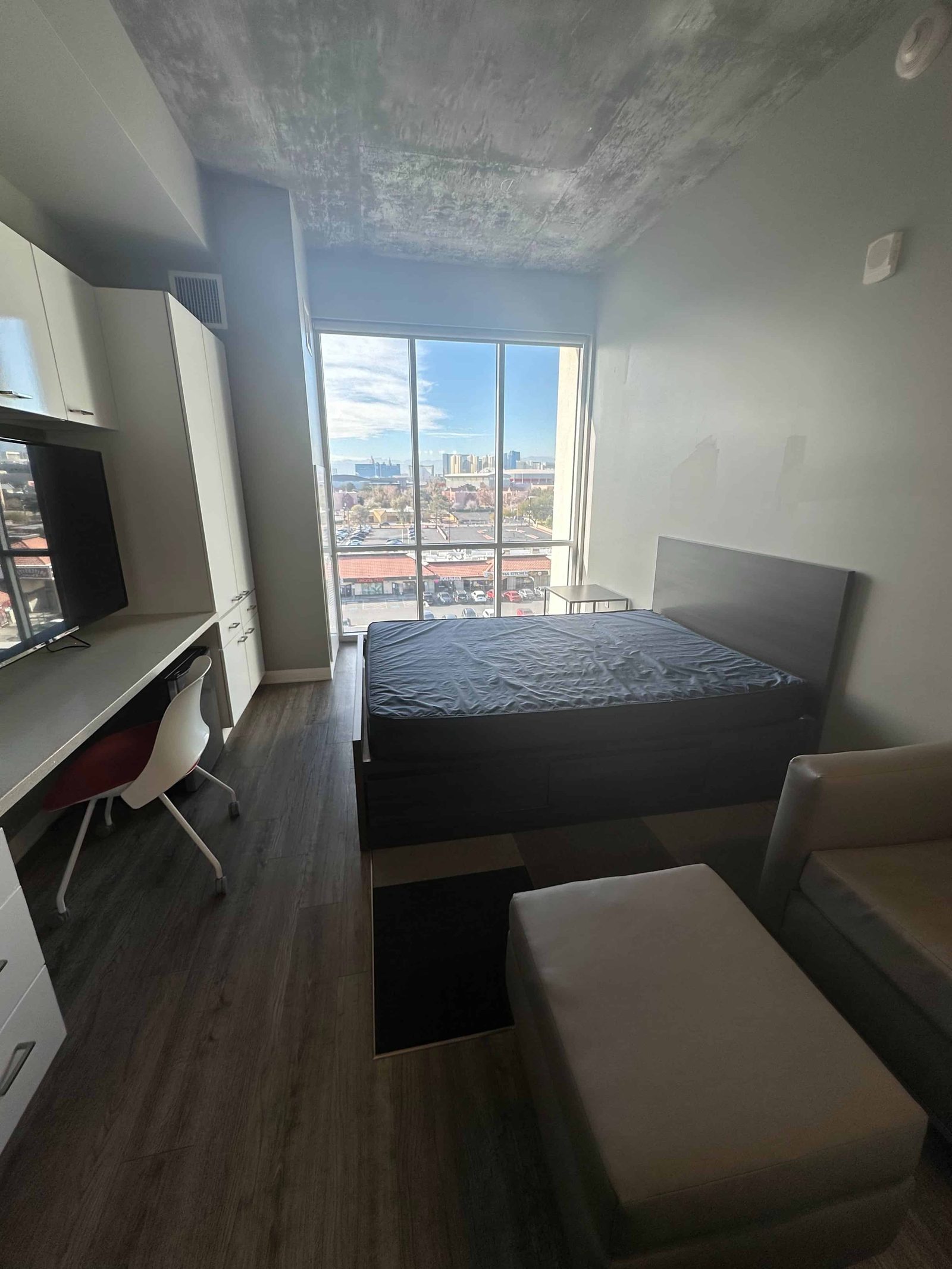
From the data provided:
- Total properties listed on the platform: 2
- Minimum monthly rent: 824 USD (indicative — confirm with the operator)
- Currency: USD
Because no maximum or average price is given, we can infer that the second property likely rents at or above 824 USD. In a city where median one-bedroom rent (general market) is around 1,100 USD, the student-oriented options start at a relatively competitive point.
Price band breakdown (based on the single data point and local market knowledge):
- Economy (approx. 800–950 USD) – Studios or shared rooms in older buildings near the university corridor or downtown. The 824 USD listing falls into this band. Expect basic furnishings, no in-unit washer/dryer, and possibly a longer lease (12 months).
- Mid-range (approx. 950–1,200 USD) – One-bedroom apartments or larger shared units in nicer complexes with amenities. These are often found in the university corridor or near the Strip (but not directly on it).
- Premium (above 1,200 USD) – Newer builds, townhouses, or properties in Summerlin/Henderson with pools and parking. Not represented in the platform data, but available on general rental sites.
What to look for in the data
Since only two properties are listed, availability is extremely tight. Most student tenants in Las Vegas rent through conventional channels (Zillow, Apartments.com, local management offices) or via university housing bulletin boards. The platform’s 824 USD entry is useful as a baseline but may not reflect the majority of options. Always confirm utilities, parking fees, and lease terms directly with the operator.
How Local Universities Map to Housing Areas
The dataset does not list specific universities, but Las Vegas hosts several higher education institutions that shape rental demand. The largest public university is located near the intersection of Tropicana and Maryland Parkway. Smaller colleges and community colleges are scattered across the valley.
General mapping of areas to typical student populations:
- University Corridor (central) – Attracts the majority of undergraduates and graduate students. Housing here is dense, walkable, and geared toward short leases. Many students seek roommates to split costs.
- Downtown – Popular among non-traditional students, art students, and those attending downtown satellite campuses. Rental prices are moderate, and the area has good bus links.
- Southwest Las Vegas (near the 215 Beltway) – Home to some college campuses and branch locations. Housing is mostly suburban apartments and townhouses. Commute times to the main university are longer (20–25 minutes), but rent is slightly lower than the corridor.
- Henderson – A commuter option for students attending the main university or the Henderson-based satellite campus. Rent can be 10–15% lower than central areas, but you need a car or a reliable bus route.
Because no specific institution names are given, the best strategy is to identify which university you will attend and then search for housing within a 5 km radius of that campus. The platform’s two properties are likely concentrated in the high-density central zone.
Three Common Pitfalls for Student Renters
1. Overlooking the Need for a Guarantor or Co-signer
Las Vegas rental operators are strict about income requirements. Many student renters cannot meet a 3× rent income threshold alone. Without a guarantor (usually a parent or legal guardian who earns at least 3× the monthly rent), your application may be rejected. The 824 USD listing may have this requirement. Always ask the operator whether a guarantor is needed and whether graduated payments are accepted.
2. Underestimating Summer Heat and Utility Costs
Las Vegas summers routinely exceed 40 °C. Air conditioning is essential, and utility bills can spike to 200–300 USD per month in peak season. The 824 USD rent may not include utilities. Check whether electricity, water, and internet are included. If not, budget an additional 150–250 USD per month. Properties with poor insulation or old A/C units can drive costs even higher.
3. Assuming the Platform’s Two Listings Represent All Options
With only two properties on the independent student-housing platform, relying solely on this source will severely limit your choices. The vast majority of rentals are listed on general sites or through university housing offices. Do not restrict your search to the platform. Contact local property managers, join Las Vegas student housing Facebook groups, and consider subletting from graduating students. The 824 USD listing is a starting point, not a comprehensive view.
Booking Calendar and Timing
For the 2026–2027 academic year, follow this timeline to secure housing in Las Vegas:
- November 2025 – March 2026: Begin research. Identify which university you will attend and the neighbourhoods within a 30-minute commute. Set a maximum rent budget (include utilities). Check if the platform updates its listings — the two properties may appear or disappear.
- April – June 2026: Peak listing season. Most student-oriented properties in Las Vegas release availability for August move-ins. Apply as early as April for the best selection. For the two platform properties, contact the operator directly to schedule a virtual tour and ask about waitlists.
- July – August 2026: Last-minute scramble. If you haven’t leased yet, you may need to expand to general rentals. Avoid signing a lease without viewing the unit or having a trusted local check it. August temperatures make in-person viewing uncomfortable but necessary.
- September 2026: Late arrivals may find leftover units at discounted rates, but the cheapest options (like 824 USD) are likely gone. Consider short-term sublets (3–6 months) if you haven’t found a permanent place.
Important note: Lease terms in Las Vegas are typically 12 months. If you only need housing for the academic year (August–May), ask about 9-month leases or find a subletter for the summer months. Some operators allow summer break lease breaks with a fee.
Frequently Asked Questions
Q: Are the two listed properties safe and legitimate? A: The platform lists independent student housing, which should be vetted for basic safety. However, with only two properties, your options are limited. Always verify the operator’s business license, read any available reviews (the dataset for Las Vegas does not include reviews), and consider visiting the property in person or asking a local contact to inspect it. Never wire money without a signed lease.
Q: Is 824 USD per month realistic for a student budget in Las Vegas? A: It is on the lower end of the market. With utilities, expect to pay roughly 1,000–1,100 USD per month total. Shared apartments can drop to 700–800 USD per person, but the platform’s 824 USD likely refers to a private studio or room in a shared unit. Confirm the exact unit type with the operator. Off-campus options in the university corridor often range from 800–1,200 USD.
Q: How do I commute to campus if I live outside the corridor? A: The public transit system (RTC) covers most of the valley. The SDX (Strip and Downtown Express) and the local routes (especially 109, 206, and 209) serve the university corridor. A monthly bus pass costs about 65 USD (indicative — confirm with RTC). Driving is faster but adds parking costs (100–200 USD per semester on campus). Many students use a combination of biking and bus.
Q: What should I do if no listings meet my needs? A: Expand your search to general rental websites, local property managers, and university housing classifieds. Consider renting a room in a house (often cheaper per person) or subletting from a graduating senior. The two platform listings are a starting point, but the broader market has hundreds of options. Always negotiate rent and ask about move-in specials (e.g., one month free) that could lower the effective monthly cost.
Data as of the latest available update in early 2026. All prices are indicative and must be confirmed with the operator. Housing market conditions change rapidly; verify availability and terms before making any commitments.
See also: listing details · browse more