Housing Near Yeshiva University
Yeshiva University is located at 500 W 185th St in the Washington Heights neighborhood of Upper Manhattan. The university holds a QS World University rank of 624 and a Google rating of 4.4 based on 99 reviews. Washington Heights offers a mix of pre-war buildings, newer developments, and relatively more affordable rents compared to downtown Manhattan, while still providing reasonable access to the rest of New York City via subway and bus lines. Below is a practical guide to finding housing near the campus, grounded in student reviews and neighborhood conditions.
What Campus Reviews Reveal
Student reviews offer a nuanced picture of life at Yeshiva University, particularly regarding housing and administrative support. A highly positive review from Gary Osterloh (5 stars) highlights the academic environment:
“At Yeshiva University, the academic structure is intentionally demanding and personal. Classes are generally smaller, faculty interaction is frequent, and students are expected to engage directly with both professors and peers. It is difficult to remain anonymous. Participation, analytical thinking…”
This suggests that students who thrive in a rigorous, small-class setting may find the experience rewarding. However, a one-star review from Franciesca L raises significant concerns for prospective students:
“They are terrible at explaining loans, didn’t approve my financial until 3 weeks before starting school. If you are not from NYC they don’t help with housing or anything. If I didn’t pay the deposit I would have went to a different program where they actually help their students.”
This review points to a gap in housing support for students arriving from outside New York City. The university itself does not appear to offer extensive assistance with off-campus housing, meaning international students or those without local connections may need to arrange accommodation independently. Another five-star review from 叶晨丰 notes: “Very nice interior! However, I heard that they are slow in their remission process for tuitions but that shouldn’t be a problem anymore.”
The review about slow tuition remission, though dated, indicates past administrative delays that may still be relevant when planning finances for housing deposits and rent. The positive rating also confirms that the campus interior is appealing, but this does not extend to the building exteriors: a one-star review from A (5 months ago) states: “The ugliest college campus in the United States. Why won’t they renovate it? Beautify this campus.”
These reviews, taken together, suggest that students should:
- Plan housing search well ahead of the start date, especially if coming from outside NYC.
- Budget for upfront costs (security deposit, first month rent) without relying on fast financial aid processing.
- Expect a functional rather than aesthetically polished campus environment.
City Context: Washington Heights
Washington Heights sits at the northern end of Manhattan, bordering the Hudson River to the west and the Harlem River to the east. It is a densely populated, primarily residential neighborhood with a large Dominican population, known for its strong community feel, affordable food markets, and access to green spaces like Fort Tryon Park and the Cloisters. The neighborhood is served by the A and 1 subway lines, plus several bus routes.
Compared to midtown or downtown Manhattan, rents in Washington Heights are noticeably lower—often by 30 to 50 percent—for comparable unit sizes. However, the neighborhood has seen steady development over the past decade, with new luxury apartment buildings rising alongside classic pre-war units. Commuting to the campus is straightforward, as the university sits within the neighborhood itself.
For students, the key trade-off is between living within a 10-minute walking radius of campus (mainly pre-war walk-up buildings and converted multi-family homes) versus commuting from cheaper blocks further north or east. Proximity to campus reduces transit costs and time but limits housing options, while a slightly longer commute opens up newer buildings and lower rent per square foot.
Budget Bands
All figures below are indicative prices for the 2026-2027 academic year—confirm with the operator, landlord, or listing site before committing.
Low budget: $1,100 – $1,700 per month (indicative)
- Shared apartment (2-3 roommates) in a pre-war walk-up within a 15-minute walk of campus
- Typically means individual rent for a room in a 3-bedroom or 4-bedroom apartment
- May include utilities (heat, hot water); electricity is usually extra
- Often requires a guarantor or upfront payment of multiple months
Mid budget: $1,800 – $2,500 per month (indicative)
- Studio or one-bedroom apartment in a walk-up, or a room in a doorman building
- Located within a 20-minute walk or a short subway ride (A train to 181st Street or 1 train to 191st Street)
- More likely to include laundry in the building, dishwasher, and elevator access
High budget: $2,600 – $4,000 per month (indicative)
- Modern studio, one-bedroom, or two-bedroom in a new development with amenities
- Directly adjacent to campus or in buildings with 24/7 doorman, gym, roof deck
- May include a second bathroom or in-unit washer/dryer
Students on a tight budget should also consider shared rooms in dorm-style apartments operated by private co-living companies, which sometimes rent single rooms in Washington Heights for $1,200 to $1,500 (indicative). Check listings carefully for utility caps and move-in fees.
Walk vs. Transit Trade-Off
Yeshiva University’s main campus is on 185th Street, between Amsterdam Avenue and the Hudson River. The immediate area has a moderate number of rental options: pre-war elevator buildings along Fort Washington Avenue, walk-up brownstones on side streets, and a handful of luxury towers near the Hudson.
Walking radius (0–15 minutes): The core campus area is walkable to all essential services (grocery stores, pharmacies, laundromats, diners). Within a 10-minute walk, you will find the A train at 181st Street (express in Manhattan, local in Brooklyn) and the 1 train at 191st Street (local only). Walking to campus from these stations takes roughly 5 to 12 minutes. Students who live within this radius can reasonably avoid any transit costs for daily campus trips. The downside: buildings in this prime area tend to be older (pre-1940s) and may have less soundproofing. Rent premiums are modest but real.
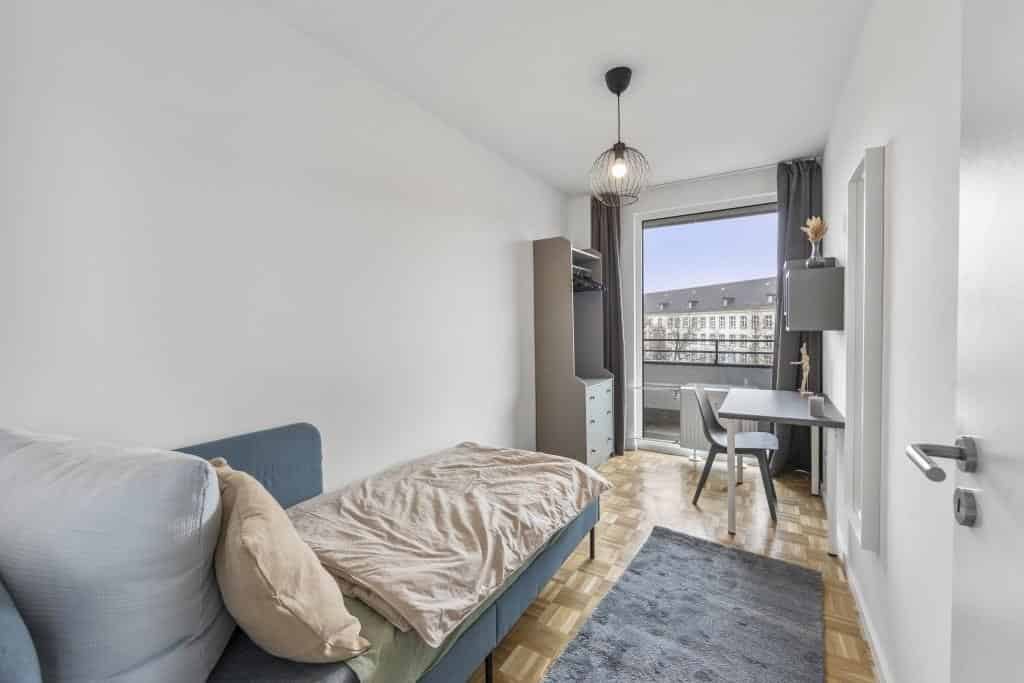
Transit-dependent zone (15–30 minutes by subway + walk): The 1 train line extends north to 215th Street (Marble Hill) and south through Manhattan. The A train runs parallel and faster. Students can consider living farther north (Inwood, or even the Bronx near Marble Hill) or south (Harlem, Morningside Heights, Hamilton Heights). Commutes to campus typically require a ride to 181st or 191st, plus a 5- to 10-minute walk. This trade-off yields lower rent—often $200 to $500 less per month—at the cost of 15 to 30 minutes of travel each way. Monthly subway costs add approximately $127 for a monthly MetroCard or $2.90 per ride.
Car or bicycle: Driving and parking in Washington Heights is difficult, with limited street parking and expensive garages. Bicycling is feasible on the Hudson River Greenway, which runs along the west side of Manhattan, but hills in the neighborhood are steep. Most students rely on walking and subway.
Shortlist Logic Using Nearby Residences
Given that the university lacks a strong on-campus housing support system (as noted in the reviews), students should evaluate housing based on the following shortlist criteria:
- Distance from campus (walking vs. transit)
- Building quality and age
- Safety of the immediate block (street lighting, foot traffic at night)
- Price per square foot relative to room count
- Lease flexibility (guarantor policies, sublet permission)
No specific residence names are provided in the available data. Below are general neighborhood zones to target:
- Fort Washington Avenue corridor between 181st and 190th streets: Pre-war elevator buildings with large apartments. Many have doormen and laundry. Walking distance 5–12 minutes. Mid to high budget.
- East of Broadway (Amsterdam Avenue and St. Nicholas Avenue): Walk-ups and small multi-family buildings. More affordable, but longer walk to campus (15–20 minutes). Low to mid budget.
- Near 181st Street A train station (west of Broadway): Convenient for subway access. Mix of pre-war and new construction. Mid to high budget.
- Inwood (207th Street to 215th Street, west of Broadway): Cheaper than Washington Heights proper. Requires a subway ride + walk. Mid budget.
- Hamilton Heights (145th to 155th streets, east of Broadway): Historically Black neighborhood undergoing gentrification; some affordable studios and shares. Transit: take A train to 181st, then walk. Low to mid budget.
When shortlisting, verify that the building is rent-stabilized if possible, as this caps annual increases. Avoid buildings with a history of housing violations (check the NYC Department of Housing Preservation and Development database).
FAQ
Q: Does Yeshiva University provide on-campus housing for graduate or undergraduate students?
Based on student reviews, the university appears to offer limited housing support, especially for students arriving from outside NYC. One reviewer noted that the university “didn’t help with housing or anything.” Prospective students should contact the housing or residential life office directly to check current options for on-campus dormitories or university-affiliated apartments. If none are available, plan to secure a private rental independently.
Q: What is the recommended timeline for finding an apartment near Yeshiva University?
Given that financial aid approval may be slow (as one reviewer experienced), start the housing search at least 3 months before the semester begins. New York City rentals move quickly—apartments are typically listed 30 days before move-in. If you are not physically in the city, consider a short-term sublet (1–2 months) to allow in-person viewing and lease signing after arrival. Be prepared to pay a security deposit equal to one month’s rent and possibly a broker’s fee (often 10–15 percent of annual rent).
Q: Which neighborhoods are most affordable without sacrificing a reasonable commute to campus?
Inwood (northern Manhattan) and Hamilton Heights (south of campus along the A train) offer the best balance of lower rent and manageable transit times. A studio in Inwood may rent for $1,500–$1,900 (indicative) versus $2,100–$2,600 in the Fort Washington area. Commute time to campus would be approximately 25 to 35 minutes door-to-door using the A or 1 train. Alternatively, look for shared apartments in Washington Heights to stay within walking distance while splitting costs with roommates.
Data-date: February 2026
See also: listing details · browse more