校园评论揭示什么
Shenzhen University (SZU) sits at 3688 Nanhai Boulevard in the Nanshan district, the high-tech heart of Shenzhen. On Google it holds a 4.4 rating from 163 reviews, but the feedback from students tells a mixed story that directly affects housing decisions.
One reviewer, Dariusz Prokopowicz, gave five stars and called SZU “a vibrant symbol of China’s ‘Silicon Valley’ spirit, blending rapid institutional growth with an unmatched entrepreneurial energy.” Another student, Chi Chi, also rated it five stars, noting the campus is “so big and so green, also so convenient, you can use the minibus. There’re so much canteen and the food is pretty cheap, tasty.” These positive comments point to a well-equipped, accessible university environment where commuting within the campus is easy via internal minibuses, and eating cheaply is possible on-site.
However, two one-star reviews raise serious concerns about housing and facilities for international students. Adam S, studying Chinese language for a year, wrote: “The hygiene of the facilities for international students is really bad. They don’t clean bathrooms AT ALL! no soap, piss smell is so bad it goes through to hallway. I’m very disappointed.” Treacherous Mastermind added: “No on-campus housing for language program students who came from abroad. Admissions office almost never replies to applicants. There are schools in China with much better services than this one.”
These contrasting experiences highlight a critical point: if you are a language program student or coming from abroad, you cannot rely on the university to provide on-campus accommodation. The hygiene complaint also suggests that even if you do get a room in the international student dormitory, the cleaning standards may fall short. This makes off-campus housing a nearly mandatory consideration for many international students at SZU.
城市背景:深圳南山区
Shenzhen is a fast-growing metropolis bordering Hong Kong, and Nanshan District is its technology and education corridor. The university’s address — Nan Hai Da Dao — places it within walking distance of the Keyuan metro station (Line 2) and near the Shenzhen Bay Technology Park. This is the “Silicon Valley” of China, home to Tencent, Huawei’s research centres, and countless startups.
The area around SZU is a mix of modern residential compounds, older villages with cheaper rentals, and newly built serviced apartments. Because the university is not in the city centre (Luohu or Futian), rents are somewhat lower than the most expensive parts of Shenzhen, but still high by national standards. The Nanshan district is well served by metro lines 1, 2, 5, 7, 9 and 11, with Line 2 providing direct access to the university area. Bus routes and bike-sharing are also widely available.
The local economy is driven by tech companies, so the neighbourhood attracts many young professionals and entrepreneurs. This means the rental market is competitive, but also diverse — you can find everything from a single room in a shared apartment (hezu) to a whole one-bedroom flat. Groceries, restaurants, and services catering to the expat and tech crowd are abundant.
预算区间概览
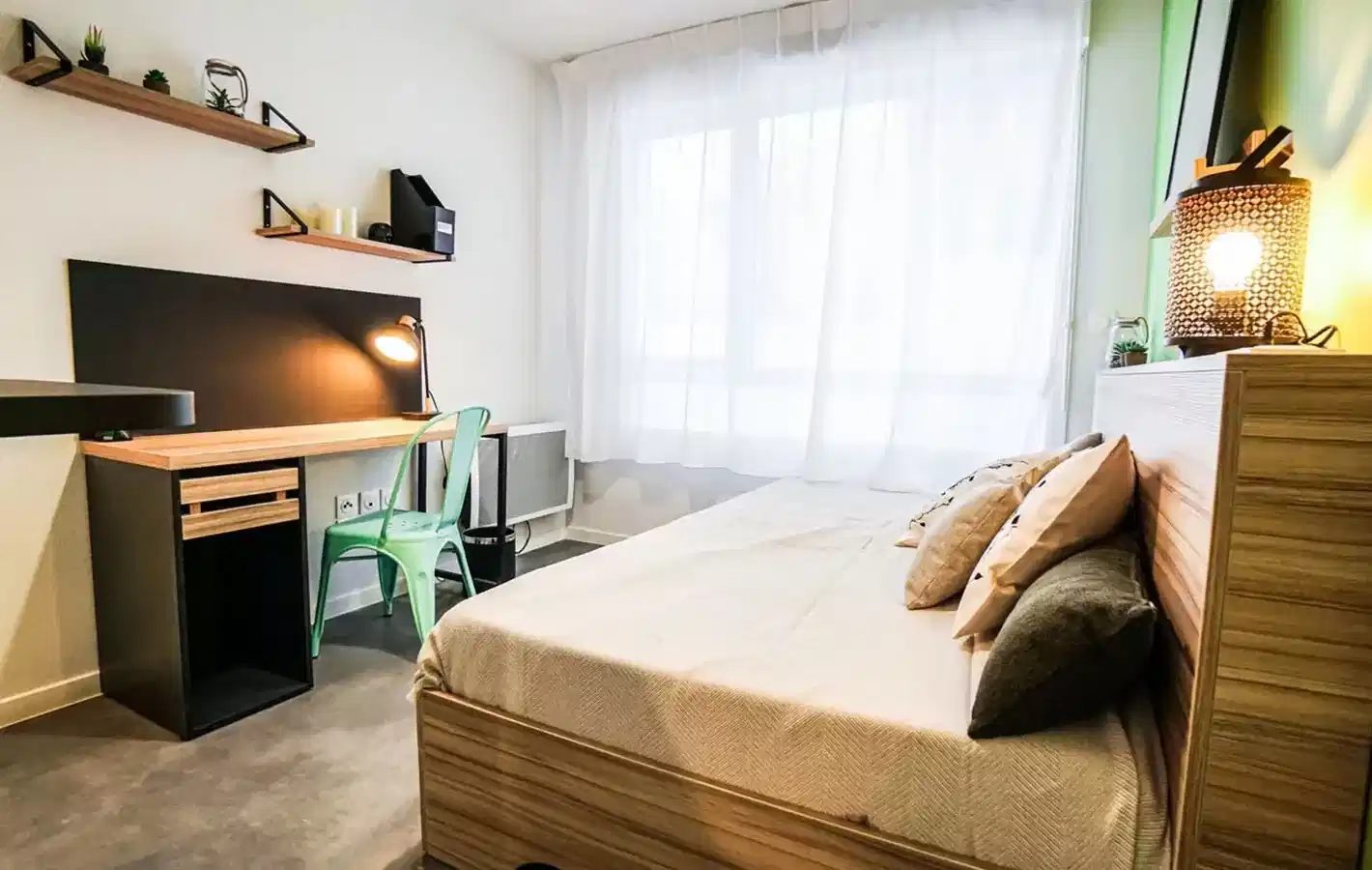
Off-campus housing near SZU can be broadly grouped into three budget tiers. Keep in mind that all prices mentioned are indicative — confirm with the operator, as they change with market conditions and lease terms.
-
Budget (~2,000–3,500 RMB/month): A single room in a shared apartment (hezu) within a 20- to 30-minute walk from campus, or a short bus/metro ride. These are usually in older residential compounds (e.g., Nanyou, Yucai Village) where rooms are smaller and may not have a private bathroom. You share a kitchen and living area with flatmates.
-
Mid-range (~3,500–5,500 RMB/month): A private studio or a larger room in a newer apartment complex within 15 minutes’ walk from the university. Many of these are in compounds like Haichang Garden, Yuexuan Garden, or near the Keyuan metro exit. You get your own bathroom and basic furniture. Some landlords include utilities and internet in the rent.
-
Upper range (~5,500–8,000+ RMB/month): A one-bedroom apartment or serviced apartment in the high-rise buildings along Nanhai Boulevard or near the Shenzhen Bay Technology Park. These often have a gym, swimming pool, 24-hour security, and are within a 5 to 10 minute walk to the south gate of SZU. Some are managed by international housing companies and include cleaning services.
Because no official rental database is provided, these figures are general observations based on the local market. Always inspect the unit in person and read the contract carefully.
步行与交通权衡
The university has two main gates: the south gate on Nanhai Boulevard and the north gate near the Keyuan metro station. The campus itself is large — a single walk from the south gate to the farthest teaching building can take 20 minutes. So “walking distance” to a teaching building may actually mean a 10-minute walk to the gate plus another 10 minutes inside campus.
Walking is ideal if your accommodation is within 1 km of the south or north gate. The closest residential compounds (e.g., Yuexuan Garden, Nanyou 12th Road area) let you be at your classroom door in under 15 minutes total. The trade-off is that these nearest blocks are in higher demand, so rents are slightly above the budget tier.
Public transport extends your options. The Keyuan metro station (Line 2) is at the north gate, and the Shenzhen University metro station (Line 1) is about a 15-minute walk from the south gate. A metro ride to the campus takes very little time — one or two stops from most of Nanshan. The trade-off is the monthly pass cost (roughly 200–400 RMB for a student using metro daily) and the time cost of walking to the station, waiting, and the extra walk inside campus.
If you choose to live further out (e.g., in Xili or Qianhai), you will rely on the metro and may need 40–50 minutes door-to-door. This is viable if you prefer lower rent, but the longer commute can be draining if you have early classes or need to stay late at the library. Some students use shared electric bikes (common in Shenzhen) to cover the final leg from the metro to campus.
短名单逻辑
Even though no specific off-campus housing list was provided with this data, the following checklist can help you build your own shortlist using any online housing platform (e.g., 58.com, Ziroom, Beike) or local agents:
-
Verify the metro line and walking time to the closest gate. Measure from the apartment door to the nearest campus gate (south or north) using a mapping app. Add 10–15 minutes for crossing the campus to your usual building.
-
Read recent tenant reviews for the compound or landlord. Look for mentions of cleanliness, noise, landlord responsiveness, and whether the rent includes water/electricity/internet. Avoid any place with a pattern of complaints about hygiene — the SZU dormitory review shows how important this is.
-
Check if the unit is in a “hezu” (shared apartment) or a standalone flat. Shared apartments are cheaper but require you to get along with flatmates. If you need quiet for studying, a standalone studio may justify the higher cost.
-
Inspect the bathroom and kitchen yourself. The negative review highlighted bad bathroom conditions. On a site visit, flush the toilet, run the shower, check for mould, and ask about cleaning schedules.
-
Negotiate the lease duration. Many landlords expect a one-year lease, but some will agree to six months, especially if you are a student. Confirm whether you can sublet or terminate early with notice.
-
Compare two or three options in the same budget band before deciding. Use the walk vs. transport trade-off as your tiebreaker. If the cheapest option adds 20 minutes of commuting each way, estimate how many hours that costs per semester.
Remember: no online listing is definitive. Always visit in person during daylight and, if possible, at night to gauge noise and safety.
常见问题 (FAQ)
Q1: Does Shenzhen University provide housing for all international students?
A: According to multiple reviews, on-campus housing is not guaranteed. One reviewer stated explicitly that language program students from abroad get no on-campus housing. Enrolled degree-seeking students may have a better chance, but it varies by program and year. It is safest to prepare for off-campus arrangements. Contact the International Student Office directly (their official website is szu.edu.cn) but be aware that response times may be slow, as another reviewer noted.
Q2: What is the average rent near Shenzhen University in 2026?
A: Indicative prices — confirm with the operator. A room in a shared apartment within 20 minutes’ walk starts around 2,000–3,500 RMB per month. A private studio near the south gate is typically 3,500–5,500 RMB. High-end serviced apartments can exceed 5,500 RMB. These figures reflect general market observations and can change without notice.
Q3: Is it better to live close to the south gate or the north gate?
A: It depends on your teaching building. The north gate faces the Keyuan metro station and the newer part of campus with many science and engineering buildings. The south gate is closer to the old campus and the humanities/language school. Use a map to find where your classes will be. If you are unsure, the area around the south gate offers more dining and convenience stores, while the north gate area is slightly quieter and more tech-office oriented.
Data date: 2026-07-01
See also: listing details · browse more