Campus Reviews: What Students Say About National Tsing Hua University
National Tsing Hua University (NTHU) sits on a 260-acre campus in Hsinchu’s East District. Student reviews on Google (4.5 stars from 2,902 reviews) paint a consistent picture: the campus is large, green, and well-maintained, but requires planning for mobility.
Bob Cook (5-star review) describes it as “a large modern university campus with nice grounds and ponds. Very pleasant place to walk around. Be aware that scooters are not allowed inside and that it really is large so allow plenty of time if you’re going between building.” This underlines a key point for housing: if you need to move between departments often, a dorm or apartment near the main gate or a specific faculty building can save daily walking time — the campus is big and vehicle-free inside.
Anindya Sundar Patra (5-star review) notes that NTHU was re-established in Hsinchu in 1956, is one of Taiwan’s National Seven Research Universities, and houses “more than 100 student clubs … and 18 dormitories” for student activities and accommodation. The 18 on‑campus dormitories are a primary option for first‑year and international students, but many upper‑year students and researchers seek off‑campus housing for more independence.
Mohammad Faizan Akhtar (5-star review) calls it “one of the Best University in Taiwan to pursue higher studies. Peaceful ambience and less crowded campus. Campus is very wide so be ready to exercise your legs.” The peaceful ambiance suggests that neighbourhoods immediately outside campus are also quiet, but the sheer size means you should check the distance from your apartment to your classroom building — especially if you have early lectures.
Washim Reza Ali (5-star review) adds: “Very beautiful campus with gardens, lake, green fields. Neat and clean and well managed, lots of eateries, cafe.” The presence of many on‑campus eateries and cafes reduces the need to go off‑campus for daily meals, but having a grocery store or night market near your home can still be convenient.
City Context: Hsinchu as a Student City
Hsinchu City is located in northern Taiwan, about a 90‑minute train ride from Taipei. It is known as the home of the Hsinchu Science Park, Taiwan’s semiconductor hub, and attracts many international students and researchers for its tech‑industry connections. The city has a mid‑sized urban feel — compact enough that you can cycle across the centre in 30 minutes, but with a public bus and local train network linking the university area to the city core and the science park.
The East District, where NTHU is situated, is a residential and educational zone. You will find a mix of older low‑rise housing and newer apartment buildings. Nearby amenities include the Big City shopping mall (a 10‑minute drive or 30‑minute walk from campus), night markets (e.g., the Dongmen Night Market, about 20 minutes by bus), and several convenience stores within walking distance of the university gates.
Climate-wise, Hsinchu has a subtropical monsoon climate. Summers (May–October) are hot and humid, often with typhoons, so air conditioning and a stable roof are important considerations. Winters (November–February) are mild but can be damp and windy because Hsinchu is known for its strong northeast winds. Housing with good insulation and windows that seal well can make a big difference in comfort.
Budget Bands for Off-Campus Housing (2026–2027 Indicative)
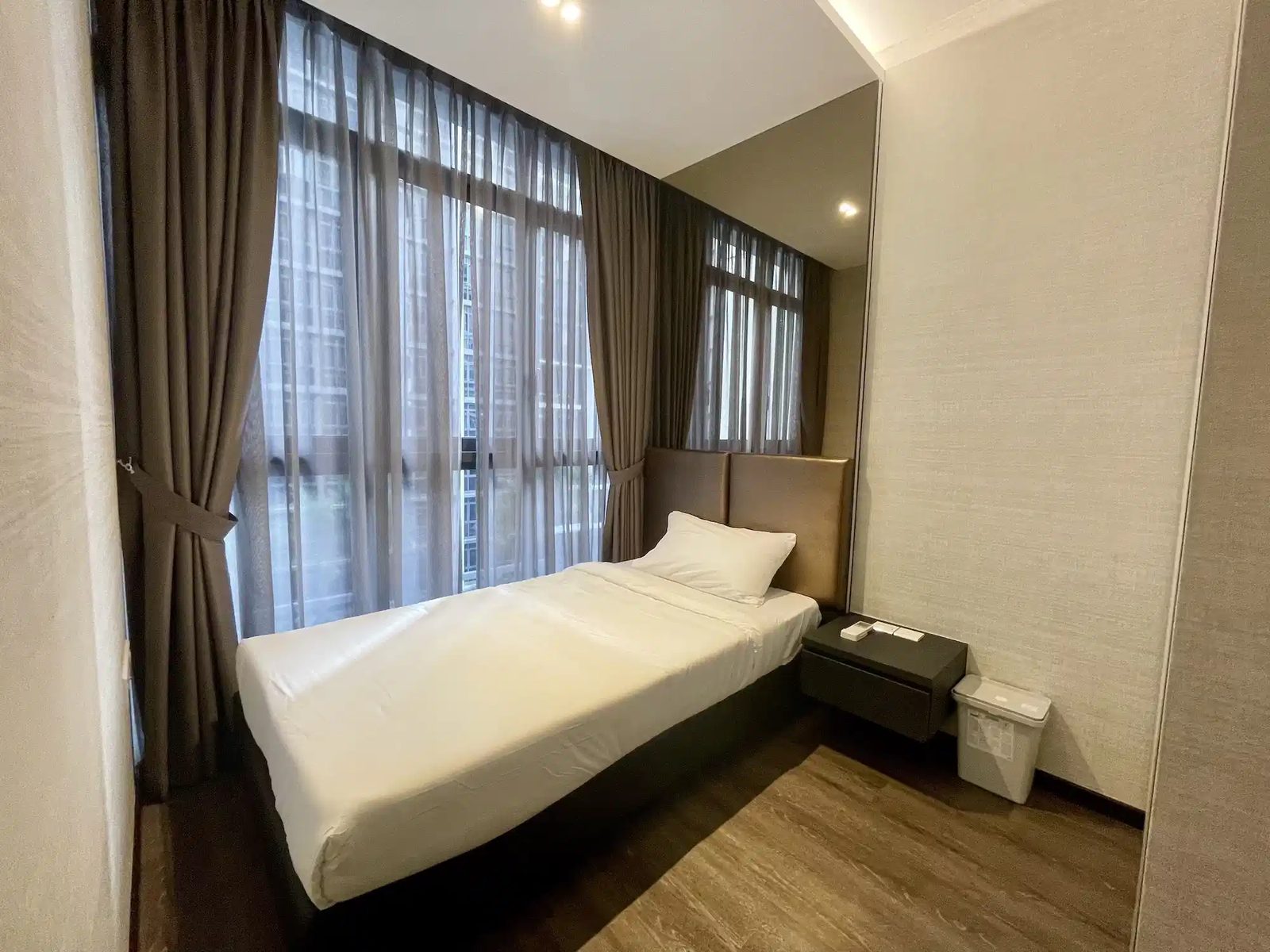
Rent prices in Hsinchu’s East District vary depending on distance to campus, room type, and building age. The figures below are indicative — confirm with the operator before signing any lease. Prices are quoted in New Taiwan Dollars (NTD) per month.
-
Budget‑friendly (NTD 4,000–7,000 per month)
- Shared rooms in older apartment buildings or “feng‑ge” (partitioned rooms in a house).
- Typically within a 15–30 minute walk from campus, or a short bus ride (5–10 mins).
- Facilities: shared bathroom, shared kitchen, often no air conditioning (window units can be added by tenant).
- Best for students who prioritise low cost and don’t mind a longer commute or shared living.
-
Mid‑range (NTD 7,000–12,000 per month)
- Private room in a shared apartment (2–4 bedrooms), or a small studio near campus.
- Usually 10–20 minute walk or a 5–10 minute bike ride to the university gates.
- Often includes basic furniture (bed, desk, wardrobe), air conditioning, and a private or shared bathroom.
- Most common choice for graduate students and long‑term renters.
-
Premium (NTD 12,000–18,000+ per month)
- Larger studios or one‑bedroom apartments in newer buildings near the main gate or Guangfu Road.
– Walking distance (5–15 minutes) to campus; some overlook the university grounds.
– Facilities: private bathroom and kitchen, in‑unit washing machine, elevator, security, often with gym or rooftop.
– Attracts postdocs, faculty, or students who want full privacy and convenience.
- Larger studios or one‑bedroom apartments in newer buildings near the main gate or Guangfu Road.
Note: Utilities (electricity, water, internet) are usually charged separately, typically NTD 1,000–2,500 per month depending on usage. Most leases require a deposit of two months’ rent.
Walk vs Transit Trade‑Off
Walking distance (0–20 min)
Living within a 20‑minute walk of the university’s main gate (Guangfu Road entrance) means you can go home for lunch, avoid bus schedules, and save on transport costs. The campus itself is large, so consider your department’s location — if you are in the College of Electrical Engineering (near the south end), a home on the east side of campus could still be a 15‑minute walk across the grounds. Nearly all off‑campus housing within this radius is in the budget or mid‑range bracket, though premium apartments exist along Guangfu Road Section 2.
Bicycle or scooter (5–15 min ride)
Many students own a bicycle or electric scooter. A 5‑ to 15‑minute ride expands your options to areas like the east side of East District (near the Hsinchu Zoo) or the north side (near the Hsinchu Train Station). Rentals for a basic bicycle cost about NTD 500–1,000 per month; second‑hand scooters can be bought for NTD 20,000–40,000 with registration and insurance. Note that scooters are banned inside the campus, so you will need to park at designated lots outside the gates — check that your housing includes free or cheap parking.
Public bus and local train
The Hsinchu City bus system has routes that stop at the campus. The Hsinchu Bus Route 1, 2, and 5608 connect the university to the train station and downtown. A single ride costs about NTD 15–25 (with EasyCard), and a monthly student transport pass is around NTD 1,200. This trade‑off lets you live in cheaper neighbourhoods further away, such as the North District or even Zhubei City (cross the Touqian River), where a private room can be NTD 3,000–5,000 cheaper than campus‑adjacent housing. However, you trade time and flexibility: buses can run every 15–30 minutes, and the commute can stretch to 30–45 minutes each way.
Walking is often the best choice for first‑year international students who are not yet familiar with the city and may need to access the language centre, international office, or dormitory frequently. Mid‑range apartments within 15 minutes’ walk of the main gate offer a good balance of convenience and cost.
Shortlist Logic: How to Choose Using the Given Context
Since no specific nearby residence names were provided in the data, the following logic uses the university’s location (Guangfu Road, East District) and the review‑based insights to help you build a shortlist of potential housing areas. When you search for “Hsinchu student housing” or “NTHU rent,” apply these filters:
-
Proximity to campus entrance
– Filter by “within 1.5 km of No. 101, Section 2, Guangfu Rd.”
– Cross‑reference Google Maps walking time from the apartment to your department building (e.g., College of Science vs. College of Engineering).
– Reviews praising the walkable campus suggest that even a 15‑minute external walk plus a 10‑minute internal walk is acceptable, but longer may feel tiring. -
Building age and maintenance
– Look for buildings built after 2000 (cities in Taiwan often list construction year).
– Older buildings may have mold, poor waterproofing, or weaker typhoon resilience.
– Reviews mention campus as “neat and clean and well managed” — aim for off‑campus housing with similar upkeep. -
Utilities and amenities
– Confirm whether air conditioning, hot water, and internet are included or charged separately.
– Check for laundry facilities (in‑unit vs. communal).
– 18 dormitories on campus have shared facilities, but many students prefer private laundry after experiencing dorm life. -
Noise and safety
– The campus is described as “peaceful” and “less crowded” — avoid units directly above 24‑hour convenience stores or main roads (Guangfu Road can have traffic noise).
– Look for gated buildings or those with a security guard.
– Ask about fire safety (smoke detectors, fire extinguishers) — common in newer buildings. -
Lease flexibility
– Most contracts are for 12 months; short‑term (6‑month) leases are harder to find.
– Some landlords accept international students without a local guarantor if you pay the deposit upfront (often 2 months’ rent).
– Use services like 591.com.tw (a Taiwan rental platform) — but remember to verify with the operator.
Frequently Asked Questions (FAQ)
Q: Is it better to live in a dorm or rent off‑campus?
A: On‑campus dorms (18 buildings according to reviews) are convenient and cheaper (typically NTD 3,000–6,000 per semester), but spaces are limited and may require applying early. Off‑campus housing gives more privacy, cooking options, and flexibility, but costs NTD 4,000+ per month. First‑year international students often live in dorms to build community; later years often move off‑campus.
Q: How much should I budget for a studio near campus in 2026‑2027?
A: Indicative — confirm with the operator. A private studio within 15‑minute walk of the main gate is typically in the NTD 9,000–14,000 per month range, plus utilities (NTD 1,000–2,500). For a shared apartment, a private room costs NTD 7,000–10,000. Budget options (shared rooms) start from NTD 4,000, but are usually further away or in older buildings.
Q: What should I check before signing a lease?
A: Visit the unit in person (or have a friend check). Test water pressure, air conditioner, and window seals. Confirm that the address matches the contract. Ask whether scooter parking is available (if you plan to use one). Verify that the lease clearly states the notice period (usually one month) and deposit‑return conditions. Because the campus is large and scooters are banned inside, also note the closest pedestrian gate to your building.
This guide is based on data available as of 2026. Prices and availability are indicative — confirm with the operator before making any commitments.
See also: listing details · browse more